The main reasons why standard domestic televisions are more prone to screen burn-in or image retention than commercial digital signage lie in differences in the choice of hardware materials, dynamic content design, and industrial-grade anti-ageing technology:
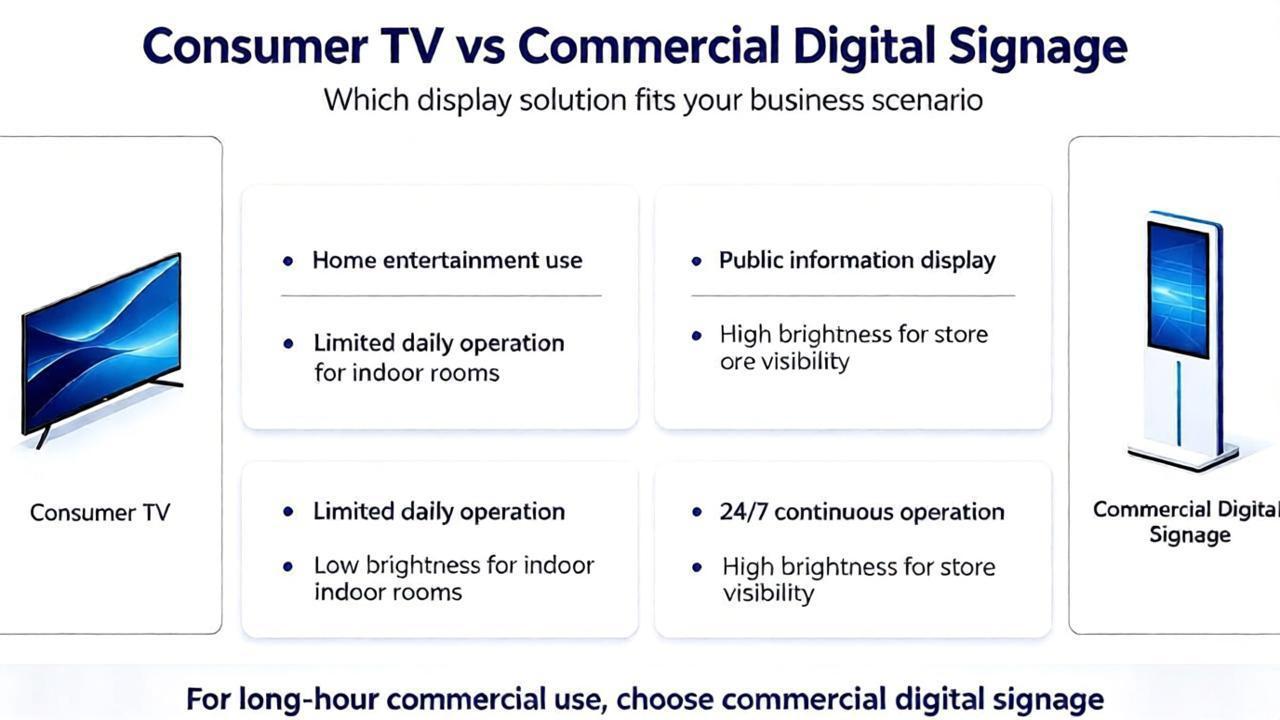
*Differences in core hardware and materials
Differences in display panels:Commercial digital signage predominantly utilises LCD (liquid crystal display) or direct-view LED screens. As liquid crystal molecules do not emit light themselves and rely on a backlight module to function, they do not suffer from permanent organic degradation caused by specific pixels emitting light at high intensity over prolonged periods, as is the case with self-emissive materials. Even when high-end digital signage employs OLED technology, industrial-grade panels with longer lifespans and superior heat dissipation are selected.
Trends in Domestic Televisions: In pursuit of ultimate colour contrast and ultra-slim profiles, domestic televisions are increasingly adopting self-emissive OLED (organic EL) panels. The lifespan of OLED’s organic light-emitting materials diminishes with use; displaying a fixed image in a specific area for extended periods (such as a station logo, news ticker or game UI) can cause premature ageing of the pixels in that area.
*Content Mechanisms and Usage Scenarios
Dynamic Content:
Content displayed on digital signage is typically professionally curated and includes frequently changing videos, scrolling captions, full-screen dynamic advertisements or scheduled image rotations; it is extremely rare for a single pixel to remain in a static, high-brightness state for an extended period.
Poor Habits in Home Use: Home televisions are frequently exposed to high-risk static scenarios, such as being locked onto a channel with a fixed logo for extended periods, watching old 4:3 films with black bars, playing games featuring static health bars or maps, or being left switched on for hours with a static image.
*Industrial-Grade Protection and Design
Heat Dissipation and Lifespan Redundancy:
As professional commercial equipment, digital signage features a more robust internal heat dissipation structure, more conservative peak brightness limits, and industrial-grade power management circuits, which significantly slow down degradation caused by thermal stress.
Automatic Software Protection:
Digital signage systems typically enforce built-in anti-burn-in strategies (such as pixel micro-shifting and timed black screen refreshes).
Whilst home OLED televisions also feature a [pixel cleaning] function, some users may disable this feature or habitually switch off the mains power, preventing the device from automatically performing screen maintenance whilst in standby mode.


 Building C27,Beidou Industrial Park,No.50 Wutong Street,High-tech Zone,Zhengzhou City,Henan Province,450001 P.R.China
.png)
.png)
.png)
.png)


